In business, I look for economic castles protected by unbreachable moats.
Warren Buffett, Berkshire Hathaway annual meeting (1995)
The Secret and the Patent
In 1886, a pharmacist in Atlanta named John Pemberton wrote down a recipe and decided never to tell anyone what was in it. He could have patented it: a clean twenty-year monopoly, enforceable in court, no vault required. He chose not to, because a patent is a bargain. The state grants you exclusivity, and in return you publish the secret for the whole world to read. After twenty years it belongs to everyone.
So Coca-Cola never filed. The formula has stayed a trade secret for nearly 140 years, because the moment you write a secret into a patent registry you've handed your rivals the map. A grand old irony: the strongest protection the law offers is the one that makes you give the secret away.
The same bind is closing on software now, with one difference. Pemberton got to choose. Founders today don't.
Copying someone else's work now costs almost nothing, and software, unlike a syrup, can't be hidden. The front end is reverse-engineerable by anyone technical enough, and the models underneath are commoditising too.
...But there's an older name for what open source does. Prometheus stole fire from the gods, gave it to mortals, and was chained to a rock to have his liver eaten for eternity in return. Open weights are fire given away on purpose: the capability a leader spent years and a fortune to build, free and in the open months later, for anyone to hold.
The Tax You Pay for Winning
Take Granola. They stayed quiet before launch, evolving the product by hand for a handful of users (Granola). It worked: they're now valued at $1.5 billion (Bloomberg). The experience they spent all that care perfecting now has open-source clones that are MIT-licensed and local, that an employed AI engineer can customise to a company in a few afternoons (e.g. Meetily).
It isn't only the small consumer tools. Legal AI is the richest enterprise software going, and its leaders are spending like consumer brands: Harvey, now worth $11 billion, and Legora, worth $5.6 billion, are fronting global campaigns with film stars, Jude Law for one and, almost too neatly, the actor who played Harvey Specter in Suits for the other.
Meanwhile a former Latham & Watkins associate has shipped Mike, a free, open-source rival you run on your own machines, handling the document review and contract work where most of the legal budget actually goes. Bear in mind he supposedly did this in a weekend. It won't match Harvey on everything, at least not yet. But it exists, it's free, and it only gets better.
So much for building in stealth or in public. Months of design experimentation and discovery investment for the entrepreneurs and VCs can now be copied nearly instantly and for a fraction of the cost. These stories will likely only become more common.
Where the Value Actually Lives
I think the clearest way to see where this ends isn't in software at all. It's in counterfeit handbags. A Louis Vuitton bag and a good fake share almost all their physical reality: the leather, the stitching, the logo, all reproducible for a fraction of the price. What can't be reproduced has nothing to do with the object. The brand. The shop on Bond Street. The certainty in the buyer's mind that this one is real. The product was always copyable and the value was never in the product, but the trust exchange. For software there's trust that the team will continue to make good things.
Many are starting to allude to software companies becoming more like fashion companies, and yes, 'feel' and cult-like allure is now part of their product differentiation. Just see how intercom have changed down the years... From a website that focuses on functional benefits, imagery as symbolic to serve that vs. a very nice-looking satellite dish in the background and a lot of pretty, grainy blue sky.
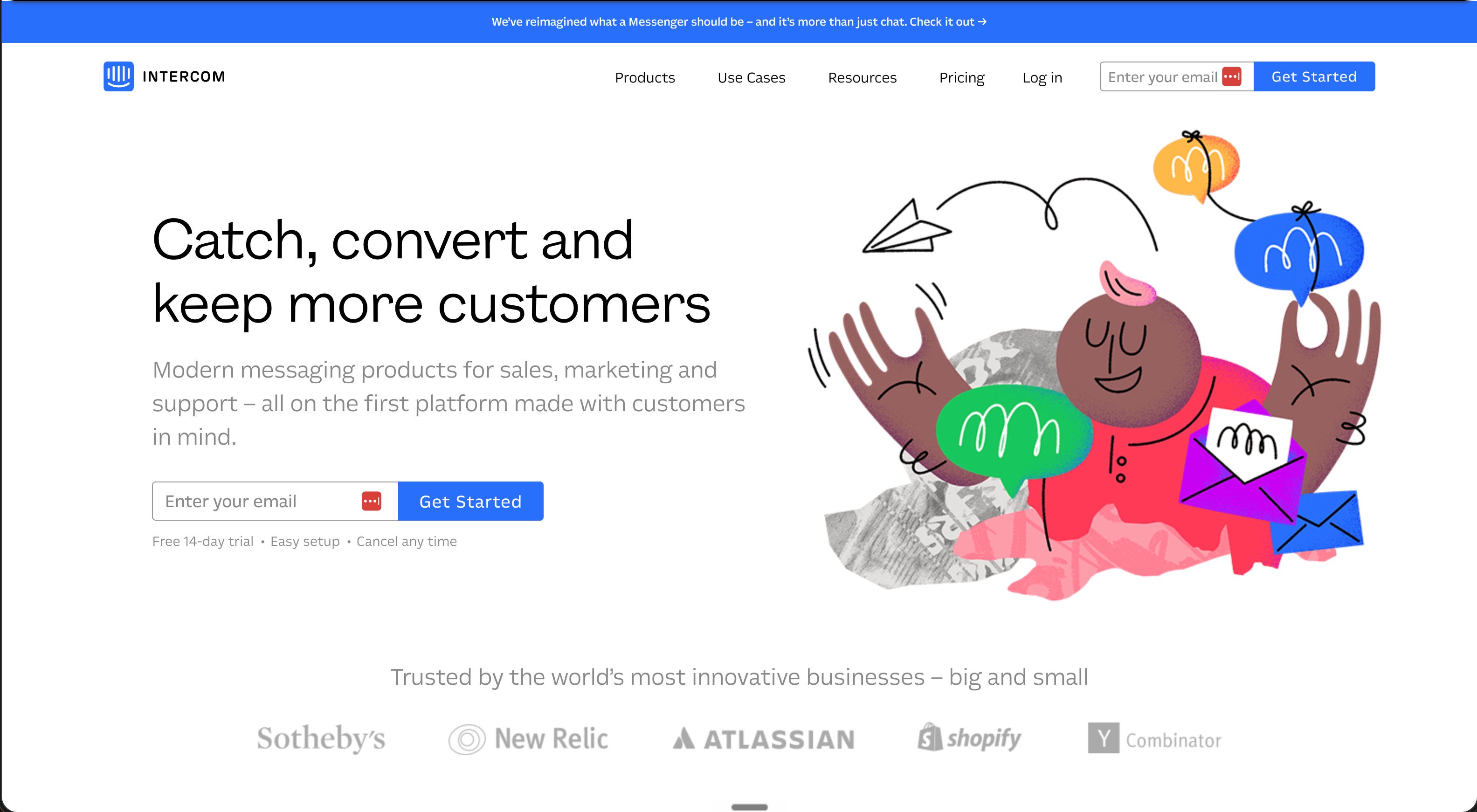
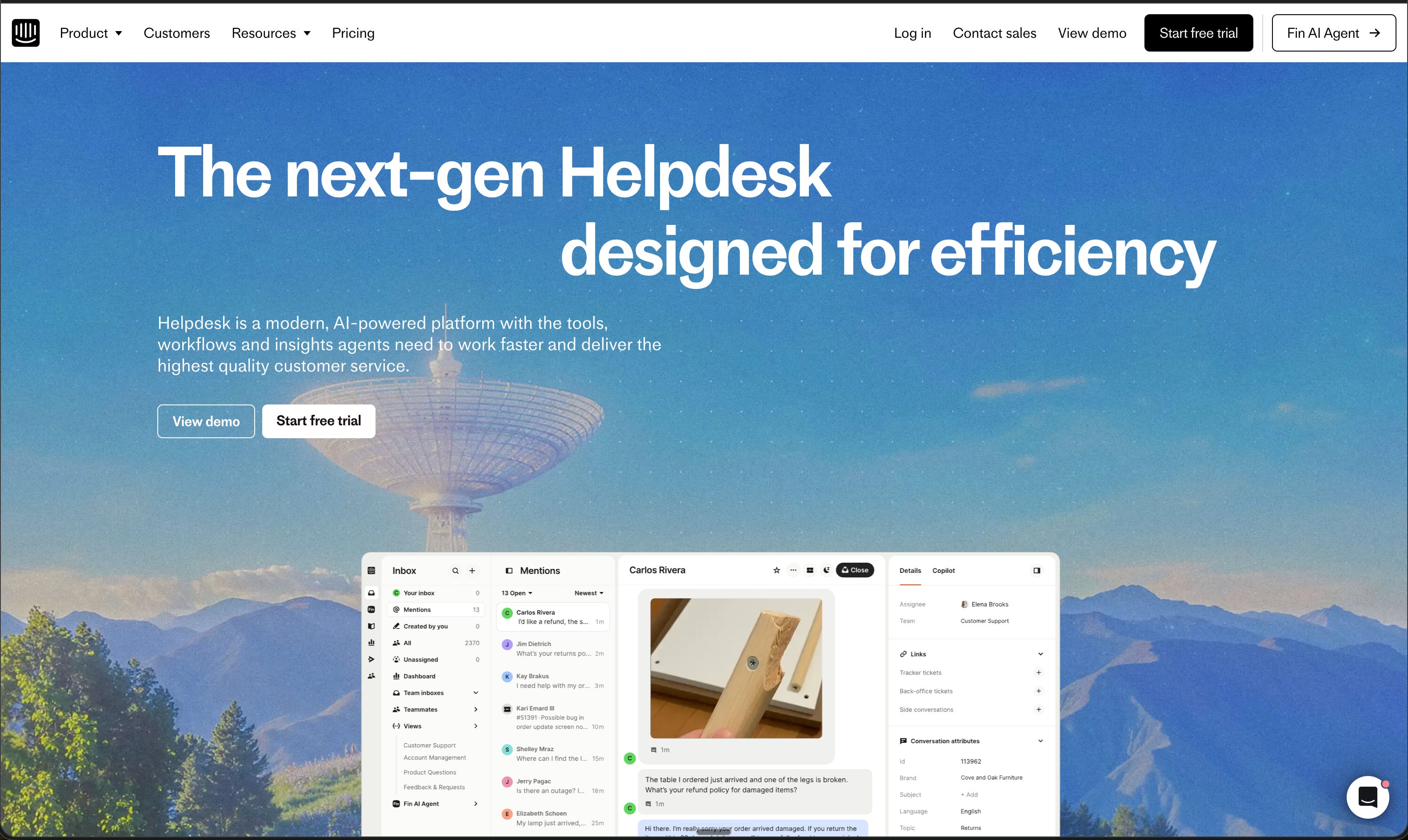
www.intercom.com, May 2018 (Wayback Machine)
Software is arriving at the same place, faster than fashion ever did. So the question is no longer how to defend the artefact. The artefact is free now. It's what you own that survives being copied, and there are two honest answers.
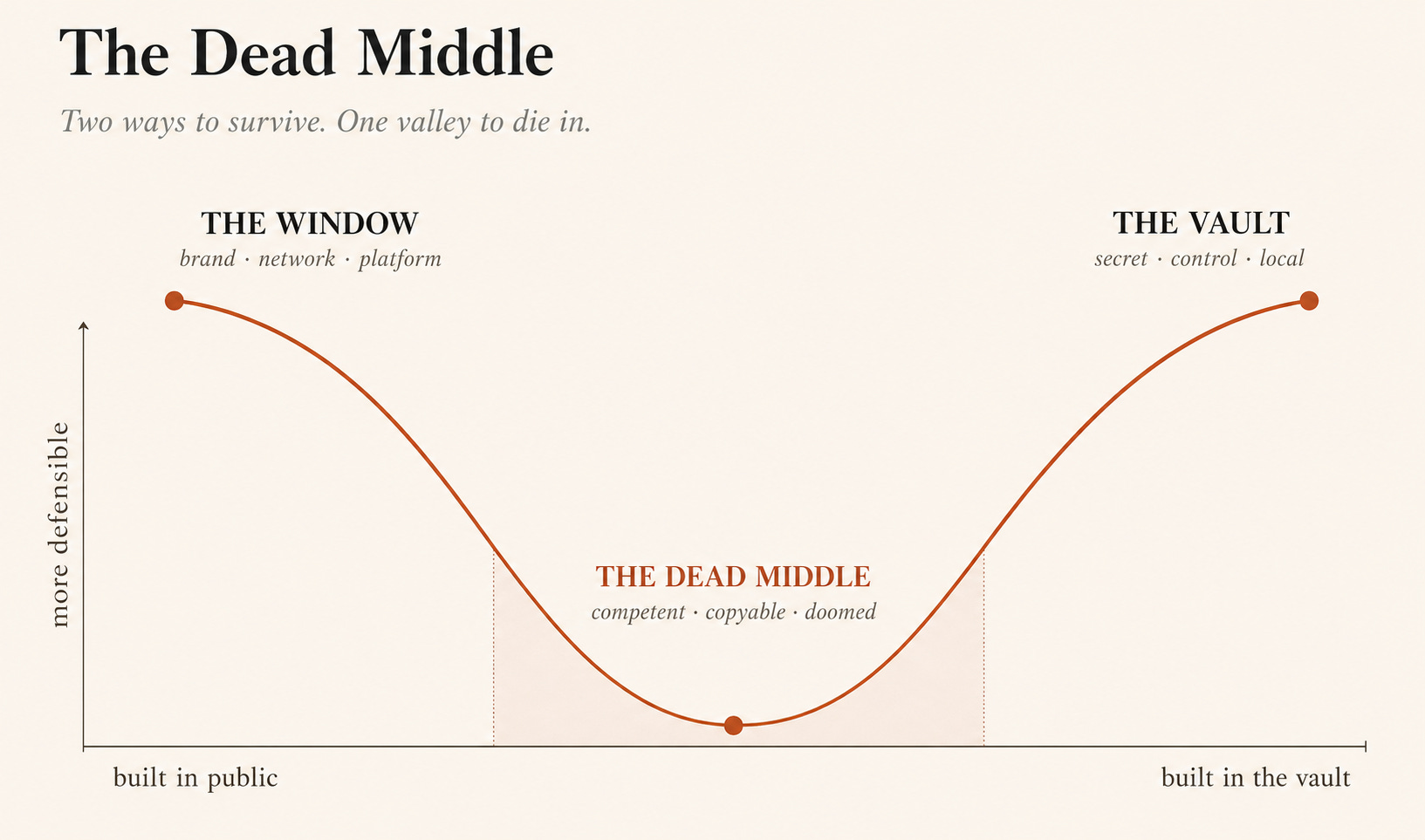
One is the Window. Build in full view, accept the product is copyable, and win on what only compounds with exposure: brand, network, a platform worth more the more people are on it. The other is the Vault. Stay genuinely unexposed, like Palantir, whose moat lives in classified deployments, forward-deployed engineers and switching costs rather than anything you can screenshot. Coca-Cola sits in the Vault, Louis Vuitton in the Window, both are defensible strategies for exactly opposite reasons. The choice until now seems straightforward...
Cyber's choice
However, copying is only the first reason to choose the Vault. The second is that the same models are getting genuinely good at breaking in. The UK's AI Security Institute, in London, reckons the length of cyber task a frontier model can run unaided is doubling every 4.7 months, faster than its own estimate from months earlier (AISI). One model, in tests, worked through a 32-step attack on a simulated corporate network on its own.
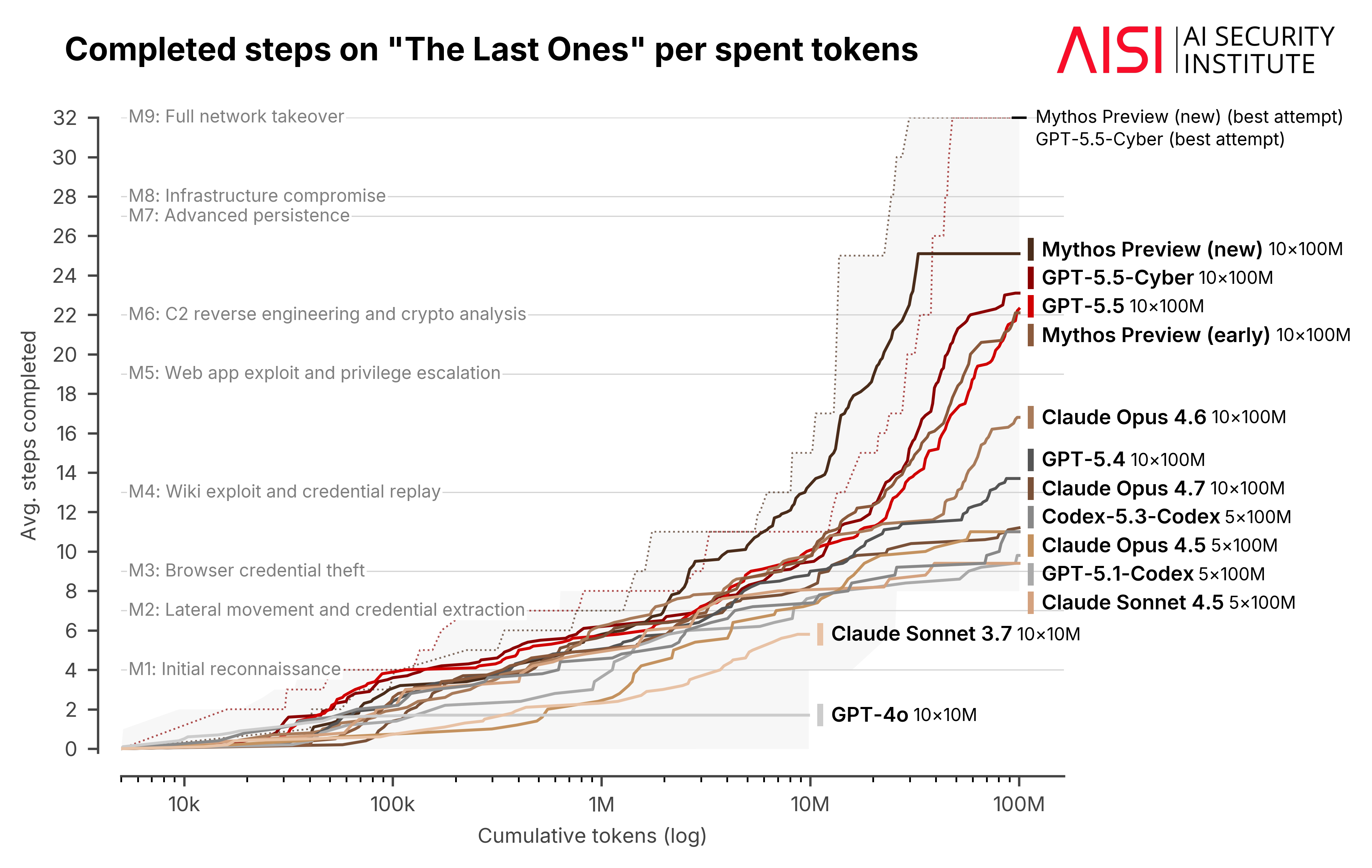
Average number of steps completed on "The Last Ones" (a 32-step simulated corporate network attack) as a function of total token spend. Each line represents a different model, with the shaded region showing the min–max range across all runs at each token budget.
Set that beside how we're building. Chains of agents hand work to each other in milliseconds, over internal traffic no firewall was built to watch, and one poisoned agent can daisy-chain into a backend that trusts it (Help Net Security). A public, venture-scale company invites clones and attackers in the same breath, and scares off the customers who won't put their data in a system they can't see.
My bet is a lot of software quietly goes dark. Not consumer-dark: Palantir-dark. Clandestine consultancies that sell an outcome and never show you the software, running models they own on hardware they hold. NVIDIA's DGX Spark already puts a 70-billion-parameter model on a desk (LMSYS). Why rent a copyable product over a network you don't trust, when you can own a good-enough one on a machine no one else can reach? The obvious objection holds, mind: plenty of buyers still want a big, audited vendor they can sue, not an outcome they can't inspect. For the regulated and the cautious, legible wins for a while yet.
The Dead Middle
Venture has always been a go-big-or-go-home business. The maths only works if a few bets return the whole fund, so the model is built to chase the giant, visible outcome, and it pushes every founder the same way: raise, scale, get seen, get everywhere. For fifteen years that was just good advice.
But survival was never a straight climb from small to big. Plot it honestly and you get a valley (below). The Window sits at one end, where brand and network compound the more you're seen. The Vault sits at the other, where the moat is the stuff nobody can screenshot. Both ends hold. The drop in the middle does not, and the middle is where most companies actually live: competent outfits that solved a real problem and would have been perfectly good businesses, owning neither a brand you'd cross the street for nor a secret worth hiding. Venture has always known most bets die. The new cruelty is that the venture route itself can push a viable one off the edge, onto the grandest stage at the exact moment copying went free and breaking in got cheap.
There's an old name for the choice underneath all this. Noam Wasserman called it rich versus king: take the money, scale hard and cede control to get rich, or stay smaller and sovereign to stay king (HBR). Call it cash or king. For decades the data favoured cash, the public road built the bigger companies. The wrinkle now is that the same road hands your only real moat to the open-source clones and paints the target the hackers aim at. King isn't the sentimental choice any more. It's quietly becoming the safe one.
Needless to say, if you're a founder or an investor standing at that fork, here's the one thing I'd recommend caution before you take the public road strategy. It used to be the obvious bet. Now it's a wager that what you build can withstand the threat of being copied or hacked over the next 10 years of investment / build.
What survives will win on what can't be copied: the brand on the bag, the secret in the vault, the platform nobody can leave. The product was never the moat. It was just the part we could see.
Prometheus gave the fire away and was punished for it forever. Pemberton, in 1886, locked his secret in a vault instead, and a century on it is still his (unless that one guy on YouTube cracked it). In future, strongest thing you own might be the one you never show.